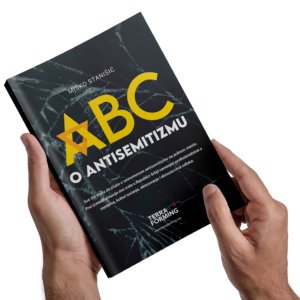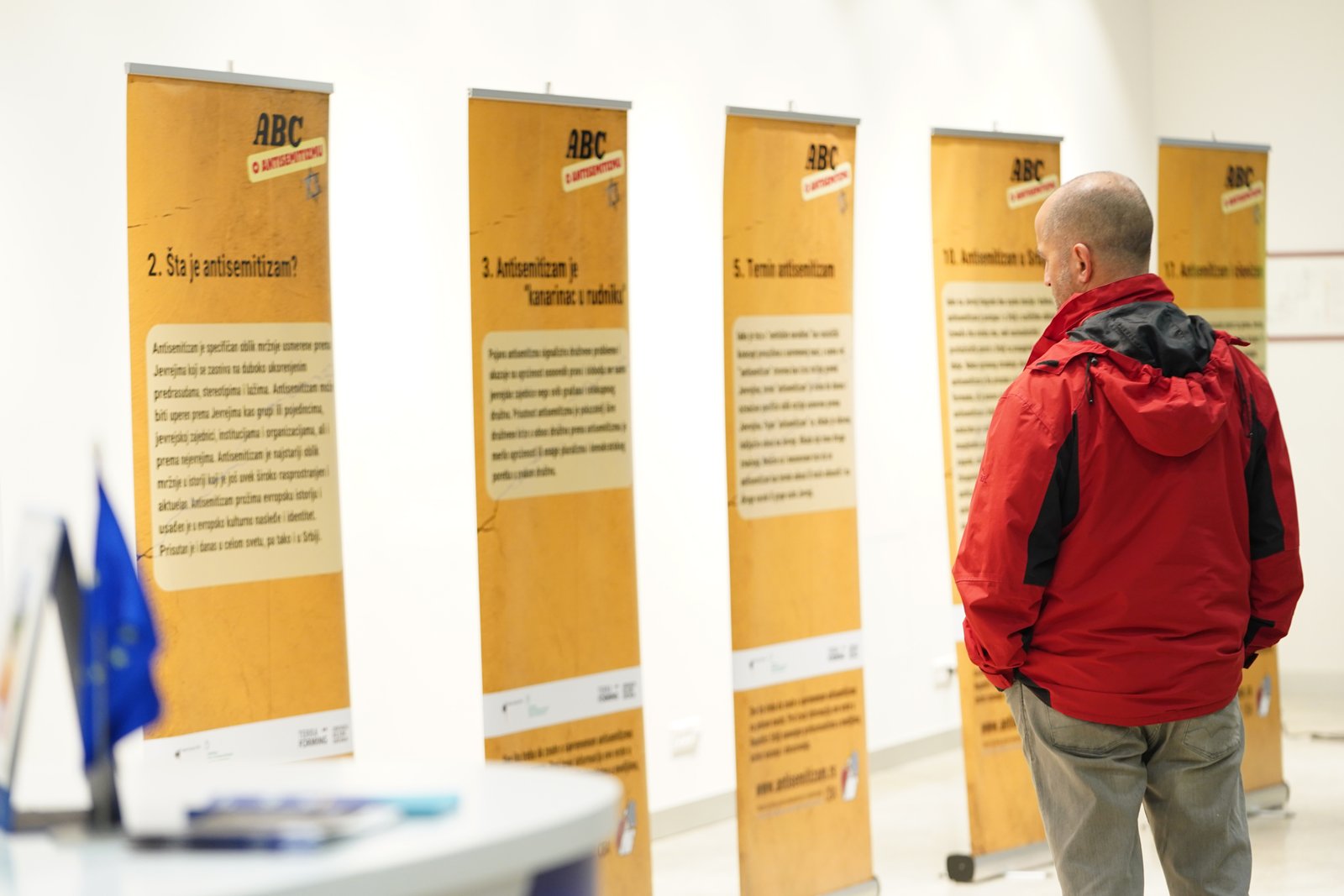
The handbook “ABC of Antisemitism” offers everything you need to know about contemporary antisemitism in one place. It is the first information resource of its kind in the Republic of Serbia, intended primarily for professionals in the media, the culture of remembrance, and education.
About This English Edition
This English edition is a translation and adaptation of a handbook originally written for use in Serbia and the Western Balkans. Its emphasis reflects regional realities, common misconceptions, forms of antisemitism, public debates and educational needs most relevant to this context. The handbook can be used more broadly, but readers should keep in mind the Serbian and regional setting in which it was developed.
Author: Miško Stanišić; Expert advisors: Dr Aleksandar Stojanović and Nevena Bajalica;
Download the PDF edition of the handbook. You can receive a printed edition by mail for the cost of delivery.
Foreword
Antisemitism is present in every European society, including our own—to varying degrees, sometimes more openly, sometimes less visibly. Unfortunately, this is nothing unusual. For centuries, antisemitism was woven into ideologies and worldviews that shaped our understanding of the world and the societies in which we live. Even today, when we understand how toxic and dangerous it is, it remains part of our collective subconscious, lurking in the darker corners of European cultural identity.
As in other countries, different manifestations of antisemitism and antisemitic attitudes can be found across the entire social and political spectrum in the Republic of Serbia: from the radical political left, through the centre, to the extreme right. We can hear it wrapped in pro-Russian and anti-EU propaganda. It occasionally surfaces in discussions on television channels with national broadcasting licences, just as it sometimes “slips out” in opposition media. We find it hidden behind political propaganda and the manipulation and misuse of Holocaust history. It can be glimpsed behind nationalist slogans and warnings that “we are under threat.” We hear it in casual everyday conversations over afternoon coffee, in passing, at work, on the bus. Sometimes we even encounter it in the classroom—voiced by a history teacher. We see it on walls covered with graffiti and in marker scribbles in lifts. We can even find it in some bookshops, openly displayed on shelves. It is almost impossible to avoid on social media. And if we look a little more closely, and more honestly, into the darkness, perhaps we may even find traces of it within ourselves.
To confront antisemitism, we must first be able to recognise it. And to recognise it, we need at least a basic understanding of what antisemitism is and how it manifests itself.
When our colleagues from the NGO Haver Serbia in Belgrade were targeted in a vicious antisemitic attack on 7 November 2023, I honestly—and naively—believed that the public in the Republic of Serbia would be appalled by the words written on the wall outside their premises: “Haver, get out of Serbia.” I was certain that the media, non-governmental organisations and civil society, as well as state institutions—including the Ministry for Human and Minority Rights, the Ministry of Education, not to mention the police and the public prosecutor’s office—would respond swiftly and forcefully. I expected them not only to condemn this shameful antisemitic act, but also to initiate a whole range of measures and activities. I thought the perpetrators would be quickly identified and brought to justice, that institutions would introduce preventive and educational measures, and that we would be better prepared to ensure that something like this would not happen again.
Instead, there was silence.
That silence shocked me even more than the attack itself. The fact that there are people willing to write “Haver, get out of Serbia” is horrifying, but imaginable. What is devastating is that, by and large, our entire society—or so it seemed—simply did not care.
The few statements that were issued, and the very limited attention the incident received in the media and wider public discourse, were nowhere near sufficient or proportionate.
On social media, by contrast, the attackers—although hidden behind avatars and without revealing their real identities—openly gloated, shared photographs of their “successful operation,” mocked others, and continued repeating antisemitic hate speech. By far the largest number of comments beneath their posts were positive and supportive. The small number of people who expressed criticism were overwhelmed by dozens of others who insulted or ridiculed them.
When I wrote a critical post about all of this on LinkedIn—a professional network where people generally communicate without the comfort of anonymity—the discussion that developed beneath my post completely shocked me. Dozens upon dozens of people, all using their full names, listing their workplaces and the companies they worked for, openly posted antisemitic statements without hesitation, shame, or apparent fear of consequences.
Alongside insults and threats directed at me personally, the “discussion” ranged from ignorance to prejudice, from lies to myths, from one increasingly bizarre conspiracy theory to the next. People explained who Jews “really are,” which wealthy Jew supposedly has more power than another and actually runs the world, how “Jewish Nazism is the worst,” whether Hitler was Jewish or merely a Khazar and a Freemason, and which Jews are “good” and which are “part of the renegade tribe.” I simply could not tell where expressions of hatred ended and complete ignorance began—or whether the two had become inseparable.
The level of ignorance was shocking, as was the fact that participants had no hesitation about saying such things publicly under their full identities. Apparently, they either genuinely believed these claims were true and part of commonly accepted opinion, or they assumed that there would be no consequences for them—legal, moral, or professional. I had assumed that, if nothing else, people might refrain from writing such things out of concern that a potential employer or business partner might find them one day.
In these discussions, I also noticed that some participants interpreted the warning that antisemitism exists in our society, and the call for a systematic response to it, as some kind of “accusation” against the Republic of Serbia or the Serbian people. Some reacted to it emotionally and aggressively, with insults and threats. This is a completely unfounded and mistaken interpretation. Opposing discrimination against citizens from minority communities is a sign of the strength and responsibility of a state and society—something that should be a source of pride for all of us, not shame.
It is important to emphasise that, alongside civil-society initiatives in this field, there are also positive examples and tendencies in institutional work. The Republic of Serbia is a member of the International Holocaust Remembrance Alliance (IHRA). On 26 February 2020, the Government of the Republic of Serbia adopted the IHRA Working Definition of Antisemitism, an important first step and a foundation for further work. Nevertheless, long-term, effective and systematic strategies for combating antisemitism are still lacking.
In the meantime, a number of further antisemitic incidents have taken place. The most serious was certainly the attack in which a radicalised Islamist who attacked a gendarme guarding the Israeli Embassy in Belgrade was killed. The attacker, a Serbian citizen, had previously surveyed potential targets: the Sukat Shalom Synagogue in Belgrade and the Jewish Community building on Kralja Petra Street, before ultimately choosing the Israeli Embassy. This shows that the targets were Jews—any Jews—not specifically Israel. Once again, however, neither public discourse nor official statements unequivocally identified the attack as antisemitic. It was described as terrorism, but the word antisemitism was not used.
The silence after the attack on Haver Serbia, the reactions that followed on social media, and the absence of institutional measures and long-term strategies for combating antisemitism—together with an insufficient understanding that such measures are needed—led me to think about what we could do, simply and quickly, to begin changing this situation in the Republic of Serbia for the better.
This led to the realisation that it would be useful to have a single reference resource containing at least the most basic information about key concepts and the most common questions and misconceptions related to antisemitism. Such a resource would need to be written in clear, accessible language and in a concise format. It should primarily serve those who shape public opinion and public understanding of antisemitism: media professionals, those working in the culture of remembrance, educators, policymakers and decision-makers.
At the same time, such a reference document should be available to everyone who cares about building a society grounded in human dignity, the rule of law, pluralism and tolerance, and who would like to broaden their understanding and consider how they themselves can help ensure that antisemitism and other forms of intolerance, discrimination and hatred are recognised and confronted before they are allowed to spread.
The result of this idea is ABC of Antisemitism—a collection of 26 sections providing concise explanations of key questions and concepts related to antisemitism.
I invite media professionals, educators, cultural professionals and decision-makers to use ABC of Antisemitism as a reference for finding answers about antisemitism, for responsible reporting, for education, and for developing policies to confront this centuries-old hatred.
January 2025
Miško Stanišić
Director of Terraforming, President of the Center for Combating Antisemitism (CBA), and member of the delegation of the Republic of Serbia to the International Holocaust Remembrance Alliance (IHRA)